Breaking Free from Perfectionism: When Good Enough Is Actually Better


Last month, a young woman walked into my Hyderabad office looking exhausted. Priya (name changed) was a software engineer at a top MNC, held a gold medal from her engineering college, and by all external measures, was extraordinarily successful. Yet she hadn't slept properly in weeks. She was working 14-hour days, rewriting code that her team leads had already approved, and had postponed her wedding twice because she felt she wasn't "ready enough."
"I just want everything to be perfect," she told me, her voice cracking. "Is that so wrong?"
In my fifteen years of practice as a psychologist and career counselor, I have heard variations of this question hundreds of times. And my answer, which often surprises my clients, is this: Yes, sometimes the pursuit of perfection is not just wrong—it is harmful.
The Perfectionism Paradox
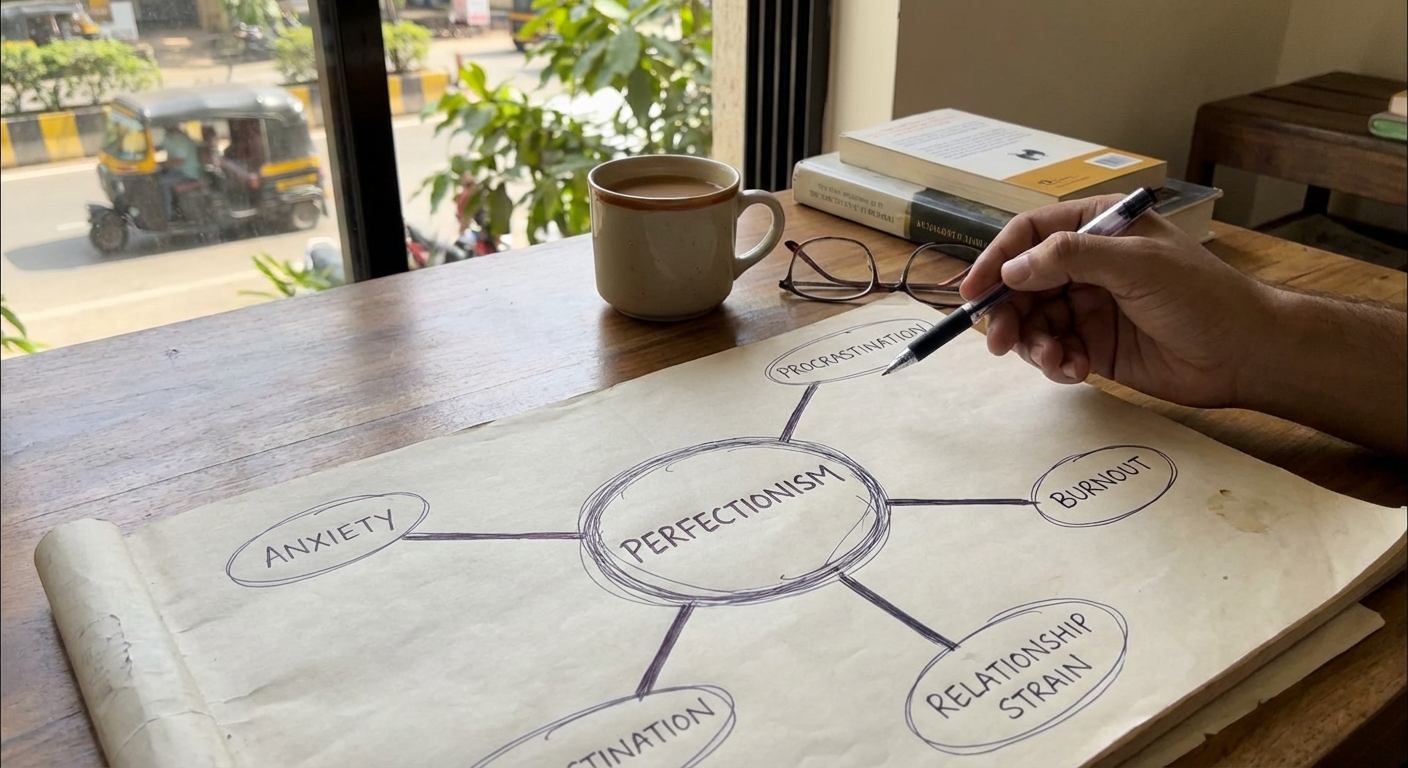
Here is something I have observed consistently in my practice: the people who struggle most with perfectionism are rarely the mediocre performers. They are the toppers, the achievers, the ones their families point to with pride. And yet, they are often the most anxious, the most burnt out, and paradoxically, the ones who feel most like failures.
This is what psychologists call the "perfectionism paradox." Research by Dr. Thomas Curran and Dr. Andrew Hill, published in the Psychological Bulletin in 2019, found that perfectionism has increased substantially among young people over the past three decades. More troublingly, their research linked perfectionism to depression, anxiety, eating disorders, and even suicidal ideation.
In India, we have a particular relationship with perfectionism. Our educational system, with its emphasis on marks and rankings, often plants the seeds early. I remember a father who brought his son to me—a Class 10 student who had scored 94% and was devastated. Devastated! Because his cousin had scored 96%. The father wanted me to help his son "improve his focus." What I actually worked on was helping both father and son understand that a two-percent difference in marks would have zero impact on this child's life, but the anxiety they were creating around it could have lasting consequences.
Understanding Where Perfectionism Comes From
In my experience, perfectionism typically stems from three sources, often intertwined:
Conditional love and approval: Many of my clients grew up in homes where love felt tied to achievement. "My parents only seemed happy with me when I brought home good grades," is something I hear regularly. This creates a deep-seated belief that one's worth is dependent on performance.
Fear of failure and shame: In our culture, family reputation—the "log kya kahenge" (what will people say) phenomenon—creates enormous pressure. Failure is not seen as a learning opportunity but as a source of shame that reflects on the entire family.
Anxiety and the illusion of control: Perfectionism often serves as a coping mechanism for anxiety. If I can just make everything perfect, the thinking goes, then nothing bad will happen. This is, of course, an illusion, but it is a powerful one.
Rahul (name changed), a CA who came to me for career counseling, exemplified this beautifully. He had been working on a business plan for three years but had never launched his venture. Every time he was about to take the leap, he would find something else to research, another scenario to plan for, another potential flaw to address. His perfectionism was not driving him toward success—it was keeping him paralyzed.

The Beauty of "Good Enough"
The British psychoanalyst Donald Winnicott introduced the concept of the "good enough mother" in the 1950s. His revolutionary insight was that children do not need perfect parents—in fact, perfect parenting would be harmful. Children need parents who are good enough: present, caring, and responsive, but also human, fallible, and imperfect. It is through experiencing their parents' imperfections that children learn resilience and develop their own sense of self.
I believe this principle extends far beyond parenting. We do not need perfect careers, perfect relationships, perfect bodies, or perfect lives. We need lives that are good enough—lives that allow us to grow, connect, contribute, and find meaning.
This does not mean settling for mediocrity or abandoning standards. There is a crucial difference between healthy striving and perfectionism. Healthy striving is internally motivated, focuses on the process, and allows for mistakes as part of learning. Perfectionism is externally driven, obsesses over outcomes, and treats any mistake as evidence of fundamental inadequacy.
Practical Strategies to Break Free
Over the years, I have developed several approaches that have helped my clients move from perfectionism toward healthier patterns. Here are strategies you can begin implementing today:
1. Practice "Good Enough" Decisions
Start small. The next time you are deciding what to eat for lunch or which shirt to wear, make a quick decision and stick with it. Do not second-guess. Notice that the world does not end when you make a choice that is merely adequate rather than optimal.
2. Set Time Limits, Not Quality Standards
Instead of working on something until it is "perfect," work on it for a set amount of time. When that time is up, submit it, send it, or move on. This is particularly powerful for those who procrastinate because they are waiting to feel ready.
3. Reframe Mistakes as Data
When something goes wrong, practice saying: "That's interesting. What can I learn from this?" This simple reframe moves you from shame (I am bad) to curiosity (that didn't work—what will?).
4. Examine Your "Should" Statements
Pay attention to how often you use the word "should." I should be further along in my career. I should be a better parent. I should have known better. These statements are often arbitrary standards we have absorbed without questioning. Ask yourself: According to whom? Based on what evidence?
5. Practice Self-Compassion
Dr. Kristin Neff's research on self-compassion has shown that treating ourselves with kindness when we fail leads to greater motivation and resilience than self-criticism. The next time you make a mistake, ask yourself: What would I say to a good friend in this situation? Then say that to yourself.

6. Create a "Done" List
Perfectionists often focus on everything still left to do. At the end of each day, write down everything you accomplished—including small things like responding to emails or having a meaningful conversation. This trains your brain to notice completion rather than perpetual inadequacy.
7. Embrace the 80% Rule
Often, the last 20% of perfecting something takes 80% of the time and energy but adds minimal value. Ask yourself: Is this additional effort actually improving the outcome in a meaningful way, or am I just feeding my anxiety?
A Story of Transformation
I want to return to Priya, the software engineer I mentioned at the beginning. After several months of therapy, she shared something that moved me deeply. She had submitted a project report with a small formatting error. In the past, this would have consumed her for days. Instead, she noticed her anxiety rising, acknowledged it, and then reminded herself: "This report communicates everything it needs to communicate. The formatting error does not change its value."
She told me, "For the first time in my life, I felt free. Not because everything was perfect, but because I realized it didn't have to be."
This is what breaking free from perfectionism looks like—not a lowering of standards, but a liberation from an impossible and unnecessary burden.

The Courage to Be Imperfect
The philosopher Brene Brown, whose research on vulnerability has transformed how we understand human connection, writes: "Perfectionism is not the path to success. It's the path to exhaustion, anxiety, and feeling never good enough."
In my years of practice, I have seen brilliant minds held hostage by their own impossible standards. I have seen relationships suffer because one partner could never accept that their spouse was human. I have seen careers stall because someone was too afraid to take a risk that might not work out perfectly.
But I have also seen transformation. I have seen the relief that comes when someone finally gives themselves permission to be imperfect. I have seen the creativity that flourishes when failure becomes acceptable. I have seen the joy that emerges when people stop performing and start living.
If you are reading this and recognizing yourself in these words, I want you to know: there is another way. You do not have to be perfect to be worthy. You do not have to achieve more to deserve love. You are enough, right now, exactly as you are.
And if you need support in making this shift, I am here to help.
---Take the First Step
Breaking free from perfectionism is a journey, and you do not have to walk it alone. If you are struggling with perfectionist patterns that are affecting your career, relationships, or mental health, I invite you to reach out. At my practice in Hyderabad, I offer individual counseling and career guidance to help you develop healthier patterns of thinking and being.
You can book a consultation by visiting my website or calling my office. Together, we can work toward a life that is not perfect, but is truly, deeply good enough.
---About the Author
Sudheer Sandra is a licensed psychologist and career counselor based in Hyderabad, India, with over 15 years of experience helping individuals navigate personal and professional challenges. He specializes in anxiety, perfectionism, career transitions, and helping young professionals build meaningful, balanced lives. Sudheer combines evidence-based psychological approaches with a deep understanding of the unique pressures facing individuals in the Indian context. When he is not in his practice, he enjoys reading, spending time with his family, and advocating for mental health awareness in the community.